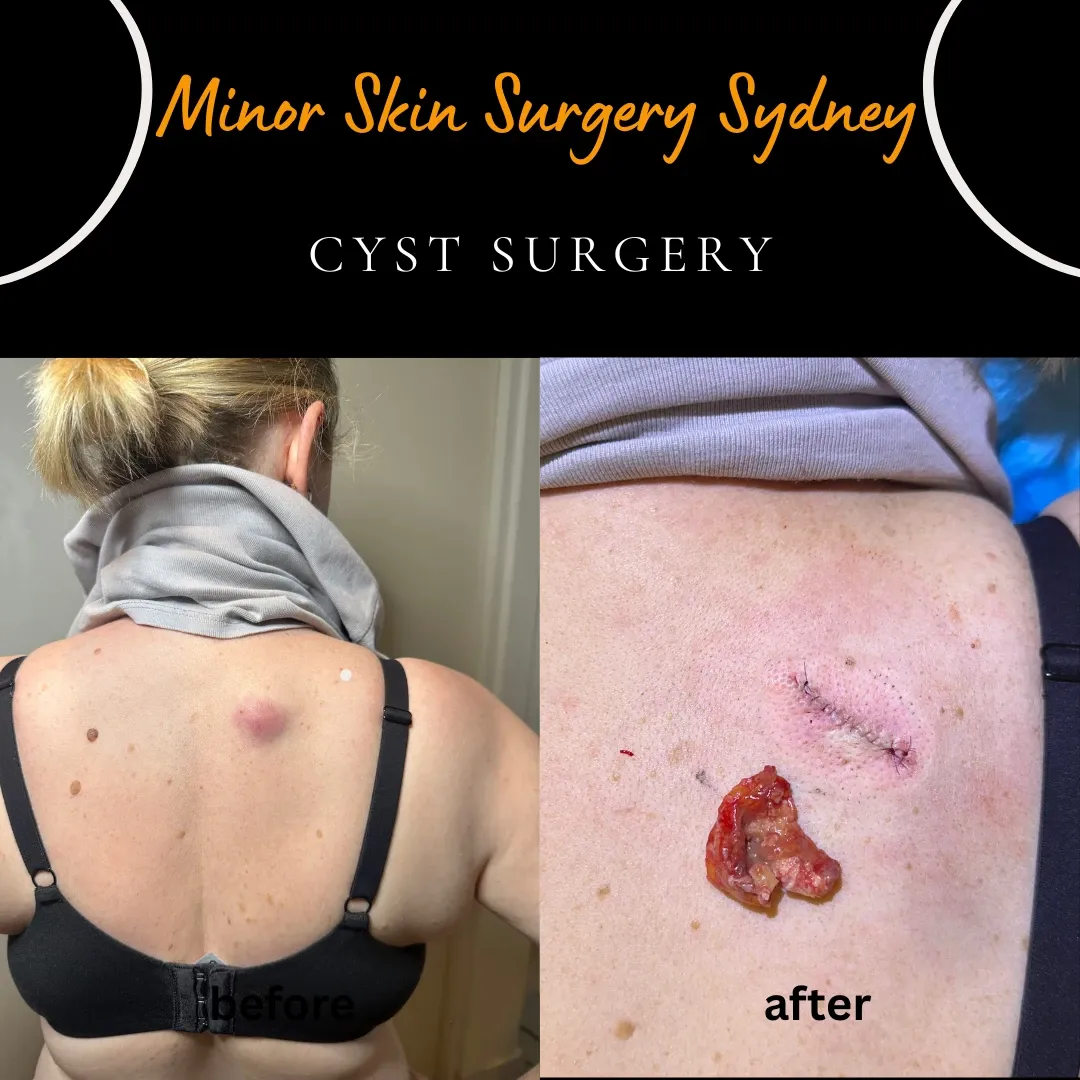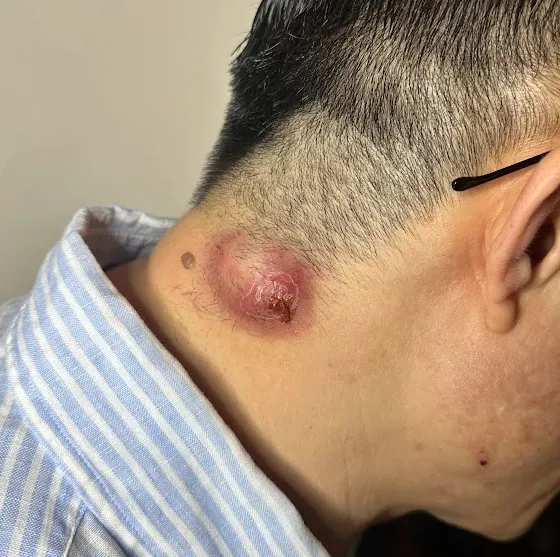
Cyst Removal Surgery Sydney | Chatswood, Cabramatta & Ryde | Dr Peter Kim
Same-Day Cyst Removal Under Local Anaesthetic
If you have a lump under your skin that has been gradually increasing in size, becoming painful, repeatedly becoming infected, or causing cosmetic concerns, surgical removal may be the most effective treatment.
Dr Peter Kim is a medical practitioner with over 20 years of experience performing minor skin surgery. Most cysts can be removed safely under local anaesthetic in our procedure rooms at Chatswood or Cabramatta, allowing you to return home shortly after your procedure.
Many suitable patients are able to have their consultation and cyst removal performed on the same day, avoiding multiple appointments.
Clinic locations
π Chatswood & Cabramatta, Sydney
π (02) 9411 4880 | 0433 284 880
Why Choose Dr Peter Kim?
Choosing an experienced surgeon is one of the most important decisions when considering cyst removal.
Dr Peter Kim offers:
β Over 20 years of surgical experience
β Approximately 1,000 minor surgical procedures performed each year
β Published author in cosmetic and dermatological surgery
β Fellow of the Australasian College of Cosmetic Surgery (2009)
β Extensive experience treating cysts, lipomas, skin cancers and other skin lesions
β Local anaesthetic procedures with minimal downtime
β Same-day surgery available for many patients
β Careful attention to cosmetic outcome and scar placement
Every patient is personally assessed and treated by Dr Peter Kim.
Β
Transparent Pricing
We believe in transparent pricing with no hidden surprises.
Consultation: $105 (Medicare rebate available for eligible patients)
Most cyst removals: Approximately $500 out-of-pocket after the applicable Medicare rebate.*
The exact cost depends on the size, location and complexity of the cyst. A personalised quote will be provided after your consultation.
Β
What Is a Cyst?
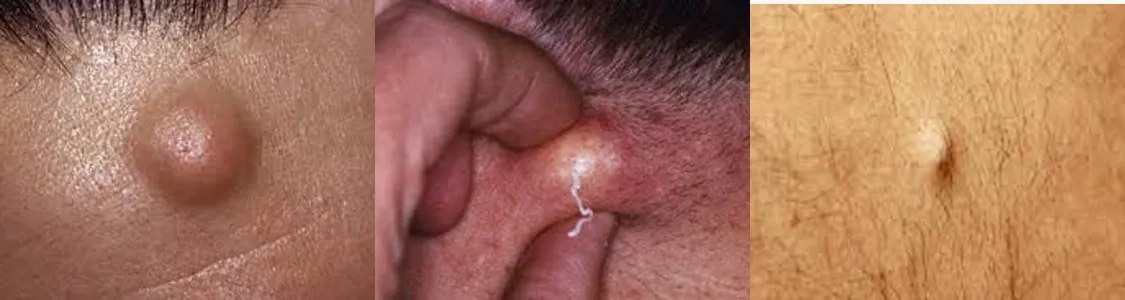
A cyst is a sac-like lump that develops beneath the skin. It usually contains keratin, oily material or fluid.
Most skin cysts are benign (non-cancerous) and grow slowly over many months or years. However, they can gradually enlarge, become inflamed, become infected or rupture.
Common types include:
- Epidermoid cysts (often called sebaceous cysts)
- Pilar cysts (commonly found on the scalp)
- Inclusion cysts
- Dermoid cysts
- Chalazion (eyelid cyst)
Although cysts are generally harmless, not every lump under the skin is a cyst. Occasionally another condition such as a lipoma, enlarged lymph node, salivary gland tumour or skin cancer may appear similar. For this reason, an accurate diagnosis is important before treatment.
When Should a Cyst Be Removed?
Not every cyst requires surgery.
Many patients simply choose to observe small, symptom-free cysts.
Removal is often recommended if:
- The cyst continues to enlarge
- It repeatedly becomes infected
- It becomes painful
- It interferes with work or daily activities
- It catches on clothing
- It repeatedly bursts and drains
- It is located in a cosmetically sensitive area
- The diagnosis is uncertain
- You would simply like it removed
Some patients seek treatment because they are worried about the lump. A consultation allows Dr Peter Kim to determine whether it is likely to be a cyst and discuss the most appropriate management.
Can Cysts Disappear Without Treatment?
Most true epidermoid or sebaceous cysts do not disappear permanently.
Sometimes the contents of the cyst drain through a small opening in the skin. Although the lump may temporarily become smaller, the cyst lining usually remains underneath the skin. Over time, the cyst often fills again and returns.
This is one of the most common reasons patients experience repeated swelling over many years.
Why Do Cysts Keep Coming Back?
Many patients ask why their cyst keeps recurring despite squeezing it or having it drained previously.
The reason is simple.
A cyst consists of:
- the contents (keratin or oily material)
- the cyst wall (capsule)
If only the contents are removed, the remaining capsule continues producing keratin and the cyst gradually reforms.
For this reason, complete surgical excision of the cyst wall offers the lowest risk of recurrence whenever appropriate.

Once a cyst becomes blocked, it will usually continue to grow and may eventually become inflamed or infected. As the cyst increases in size, surgical removal can become more difficult and may result in a larger scar.
Complete surgical removal of the cyst and its lining offers the best chance of preventing recurrence. Early treatment often allows for a smaller incision, a less noticeable scar, and an easier recovery.
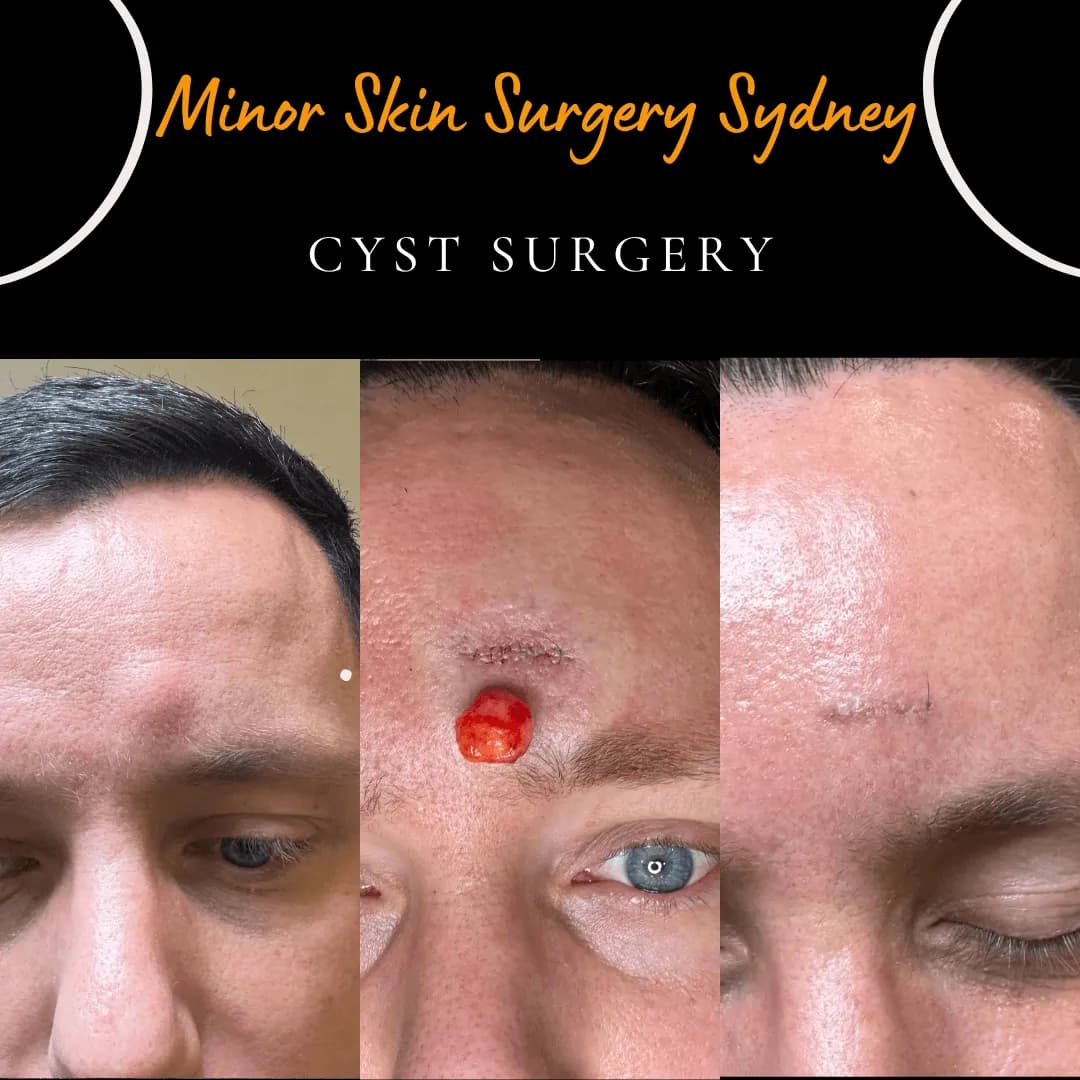
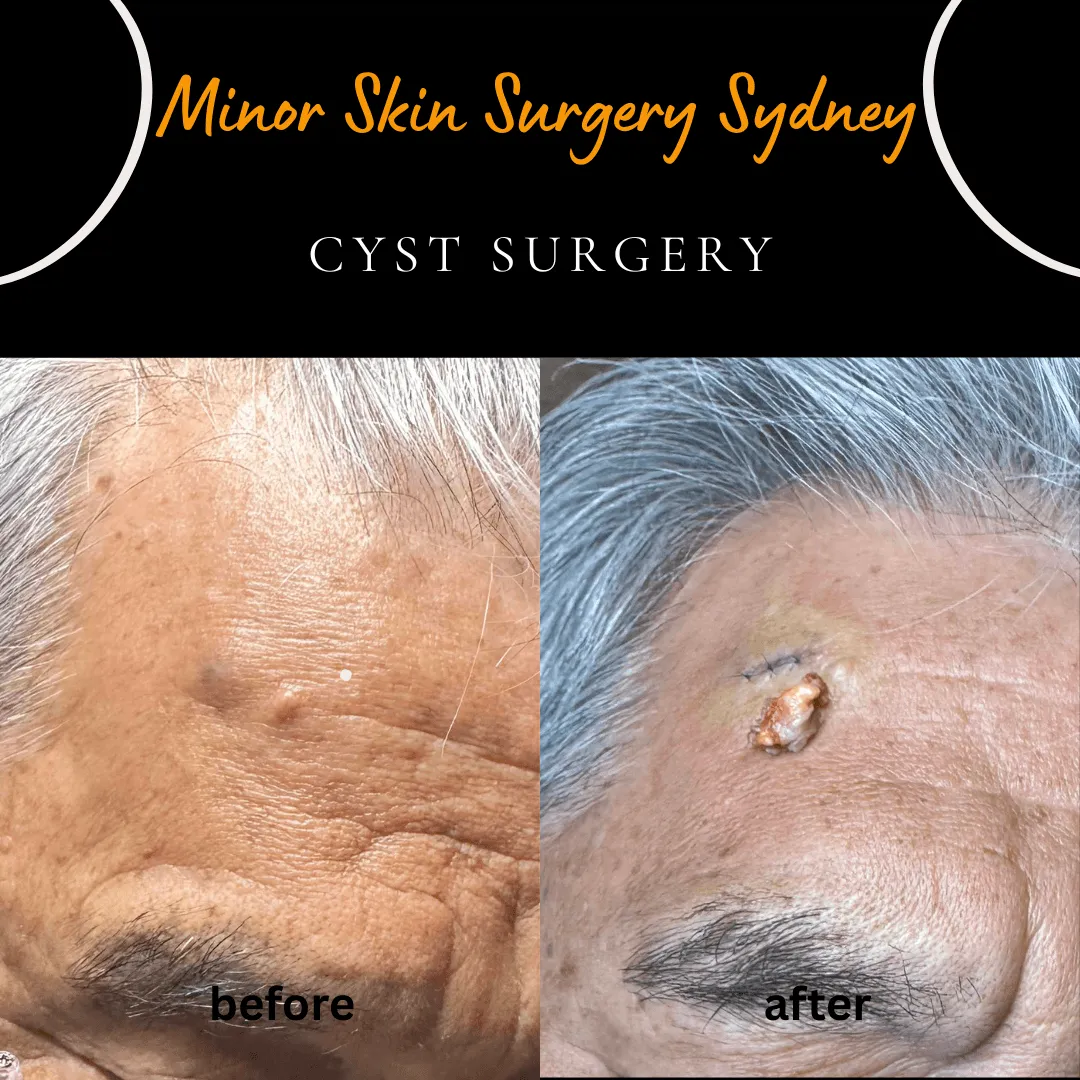
This patient presented with a cyst on the forehead that had been present for many years. Initially, the contents of the cyst could be expressed by squeezing through a small opening in the skin. Over time, the opening became blocked, causing the cyst to gradually enlarge.
Once a cyst becomes blocked, it will usually continue to grow and may eventually become inflamed or infected. As the cyst increases in size, surgical removal can become more difficult and may result in a larger scar.
Complete surgical removal of the cyst and its lining offers the best chance of preventing recurrence. Early treatment often allows for a smaller incision, a less noticeable scar, and an easier recovery.
Same-Day Cyst Removal
Many patients are pleasantly surprised to learn that cyst removal does not usually require hospital admission.
Following assessment, many cysts can be removed during the same visit under local anaesthetic.
Advantages include:
- No hospital stay
- No general anaesthetic
- Minimal downtime
- Return home shortly after surgery
- Usually only one visit required
Whether same-day surgery is appropriate depends on the size, location and nature of the lump.
What Happens During the Procedure?
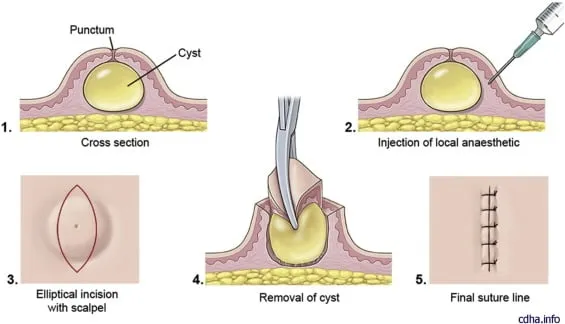
Most cyst removals are performed in our fully equipped procedure rooms.
The procedure generally involves:
Step 1 β Consultation
The lump is examined and your treatment options discussed.
Step 2 β Local Anaesthetic
The skin is numbed using local anaesthetic.
Most patients describe only brief stinging for a few seconds.
Step 3 β Removal
A carefully planned incision is made.
Where possible, the entire cyst together with its lining is removed to reduce the chance of recurrence.
Step 4 β Wound Closure
The wound is carefully closed using fine sutures.
In many cases, deep dissolving sutures are used beneath the skin together with fine skin sutures to optimise healing and cosmetic outcome.
Step 5 β Return Home
Patients usually return home shortly after the procedure.
How Long Does Surgery Take?
Many cyst removals take between 15 and 30 minutes, depending on:
- Size
- Location
- Previous infection
- Whether the cyst has ruptured
- Complexity
Smaller cysts may be removed even more quickly, while larger or inflamed cysts can require additional time.
Recovery After Cyst Removal
Recovery is usually straightforward.
You may experience:
- Mild swelling
- Bruising
- Tenderness
- Tightness around the wound
These symptoms usually improve over several days.
Most patients can return to office work within one or two days, although strenuous exercise should be avoided until advised.
Detailed wound care instructions will be provided before you leave the clinic.
Will There Be a Scar?
Any operation involving an incision leaves a scar.
Our aim is to achieve the best possible cosmetic outcome by:
- Planning the incision carefully
- Removing the cyst completely where possible
- Closing the wound in multiple layers when appropriate
- Providing scar care advice during healing
Most scars gradually soften and become less noticeable over the following months.
Risks of Cyst Surgery
All surgical procedures carry risks.
Potential risks include:
- Infection
- Bleeding
- Bruising
- Wound separation
- Delayed healing
- Recurrence
- Temporary numbness
- Hypertrophic or keloid scarring in susceptible individuals
These risks will be discussed during your consultation.
How Much Does Cyst Removal Cost?
The cost depends on several factors, including:
- Size of the cyst
- Location
- Complexity
- Whether pathology is required
After examining the lesion, Dr Peter Kim will provide an individual quotation.
For many average-sized cysts, the out-of-pocket cost is approximately $500 after the applicable Medicare rebate.
Consultation fee: $105, with an approximate Medicare rebate of $50 for eligible patients.
Is there an alternate to surgery
In some patients, particularly those with multiple cysts, a corticosteroid injection may be considered as an alternative to surgery. When administered correctly using the appropriate injection technique, corticosteroid injections can reduce inflammation and shrink the cyst. This approach requires experience and precise technique to maximise effectiveness and minimise complications. In selected patients, it may help avoid the need for immediate surgical treatment.
However, steroid injections are not suitable for every cyst and are not always successful. They do not remove the cyst wall, so recurrence remains possible. For persistent, recurrent, enlarging, or symptomatic cysts, complete surgical removal of the cyst and its lining remains the most effective treatment and offers the lowest risk of recurrence.
Β
Book a Consultation
If you have a lump that you believe may be a cyst, Dr Peter Kim can assess the lesion and discuss whether observation, non-surgical treatment or surgical removal is the most appropriate option.
Many suitable patients can have their cyst removed on the same day under local anaesthetic.
Appointments
π (02) 9411 4880
π± 0433 284 880
π Chatswood & Cabramatta, Sydney
Opening Hours
WednesdayβSaturday
9:00 AM β 5:00 PM
Important information
This information is general in nature and does not replace a medical consultation. All procedures carry risks and suitability must be assessed individually.
Infected Cysts
One of the most common reasons patients seek treatment is because a previously harmless cyst has become infected.
An infected cyst may become:
- Red
- Swollen
- Painful
- Warm to touch
- Filled with pus
- Associated with an unpleasant odour
- Difficult to sleep on or wear clothing over
Sometimes the infection progresses into an abscess, where pus becomes trapped beneath the skin.
When this occurs, the immediate priority is to treat the infection rather than remove the cyst.
Treatment may involve:
- Oral antibiotics
- Incision and drainage of the abscess
- Regular dressings
- Delayed surgical removal of the cyst once inflammation has settled
Removing an actively infected cyst is usually more difficult because inflammation makes it harder to identify the cyst wall. This increases the chance that part of the lining may remain, resulting in recurrence.
For this reason, many infected cysts are treated in two stages:
- Control the infection.
- Remove the entire cyst several weeks later after healing.
What Happens If a Cyst Bursts?
Some cysts rupture spontaneously.
When this happens, the contents leak into the surrounding tissues, causing inflammation.
Patients often notice:
- Sudden pain
- Rapid swelling
- Redness
- Tenderness
- Discharge of thick white or yellow material
Although the cyst may temporarily become smaller after bursting, the remaining cyst lining frequently continues producing keratin, allowing the cyst to recur.
Repeated squeezing or puncturing usually does not solve the problem permanently.
Can Antibiotics Cure a Cyst?
This is one of the most common misconceptions.
Antibiotics treat bacterial infection.
They do not remove the cyst itself.
If the infection settles, the lump often remains because the cyst wall is still present beneath the skin.
Many patients have already completed several courses of antibiotics before attending our clinic.
If symptoms continue to recur, surgical removal of the cyst wall may be recommended.
Is Ultrasound Necessary?
Not every cyst requires an ultrasound.
Many cysts have a typical appearance and can be diagnosed during clinical examination.
However, imaging may be recommended if:
- The diagnosis is uncertain
- The lump is unusually large
- It is located near important structures
- Previous surgery has failed
- The lesion has unusual features
- Another diagnosis needs to be excluded
Ultrasound can help determine:
- Whether the lump is solid or fluid-filled
- Its size
- Its depth
- Its relationship to nearby structures
Occasionally, ultrasound findings suggest that the lump is not actually a cyst.
This is one reason why assessment by an experienced clinician is important.
Is Every Lump a Cyst?
No.
Many different conditions can resemble a cyst.
These include:
- Lipoma
- Enlarged lymph node
- Pilomatrixoma
- Salivary gland tumour
- Branchial cyst
- Ganglion cyst
- Skin cancer
- Dermatofibroma
- Calcinosis cutis
For this reason, every lump should be assessed individually.
Occasionally patients attend expecting cyst removal, but assessment suggests an alternative diagnosis requiring different treatment.
Will My Cyst Be Sent for Pathology?
In many cases, the removed tissue is sent to a pathology laboratory.
The pathologist examines the specimen under a microscope to confirm the diagnosis.
Most cysts are confirmed as benign epidermoid or pilar cysts.
Although uncommon, pathology occasionally identifies another condition that requires further treatment.
This provides reassurance that the diagnosis is correct and ensures appropriate follow-up if necessary.
Non-Surgical Treatment
Not every patient wishes to undergo surgery.
Depending on the type, size and location of the cyst, non-surgical treatment may sometimes be considered.
One option is a corticosteroid injection.
The injection aims to reduce inflammation and shrink the cyst.
Potential advantages include:
- No surgical incision
- Minimal scarring
- Quick procedure
- Little downtime
However, injections have limitations.
They do not remove the cyst wall.
For this reason:
- Some cysts respond well.
- Others show little improvement.
- Some become smaller initially before returning months later.
Patients should understand that surgery may still be required if symptoms persist.
The most appropriate treatment depends on the individual patient and will be discussed during consultation.
Does Every Cyst Need Surgery?
No.
Some cysts can simply be observed.
Surgery is usually recommended only when the benefits outweigh the risks.
Observation may be appropriate if the cyst is:
- Small
- Stable
- Painless
- Not infected
- Not causing cosmetic concern
Many patients simply want reassurance that the lump is benign.
Can Cysts Become Cancer?
Most epidermoid and pilar cysts are completely benign.
Cancer developing within a cyst is extremely uncommon.
However, not every lump beneath the skin is actually a cyst.
If a lump behaves unusuallyβfor example:
- Rapid growth
- Persistent ulceration
- Recurrent bleeding
- Firm fixation
- Irregular borders
further investigation may be recommended.
Clinical examination remains the most important step in determining appropriate management.
Frequently Asked Questions
Is cyst removal painful?
The procedure is performed under local anaesthetic.
Most patients experience only brief discomfort while the anaesthetic is administered.
Once the area is numb, surgery is usually well tolerated.
Can I drive home afterwards?
Most patients can drive themselves home following a simple cyst removal performed under local anaesthetic.
If the cyst is in a difficult location or a larger procedure has been performed, someone accompanying you may be preferable.
Can I shower?
In most cases, yes.
Specific instructions depend on the location of the wound and dressing used.
When are the stitches removed?
Most skin sutures are removed between 7 and 14 days.
This varies according to the body site.
Can I exercise?
Light activities are usually acceptable.
Heavy lifting, contact sports and vigorous exercise should be avoided until advised.
Will I have a dressing?
Yes.
A dressing is usually applied immediately after surgery.
Instructions regarding dressing changes will be provided.
Can children have cyst removal?
Some cysts in children can be removed under local anaesthetic depending on age, location and cooperation.
This will be assessed during consultation.
Can multiple cysts be removed at the same visit?
Yes.
Many patients have several cysts removed during the same procedure.
The number depends on the size, location and expected operating time.
Can I fly after surgery?
Most patients are able to travel shortly after uncomplicated surgery.
If you are planning overseas travel, please discuss this during your consultation so surgery can be scheduled appropriately.
Why Choose an Experienced Doctor?
Although cyst removal is considered a minor surgical procedure, every incision leaves a scar. Achieving the best cosmetic outcome requires careful planning and meticulous surgical technique.
Like any skill, performing the same procedure repeatedly leads to greater expertise. Dr Peter Kim performs approximately 1,000 minor surgical procedures each year, with cyst removal forming a significant part of his practice. This extensive experience has refined his surgical technique and attention to detail.
Experience is particularly important when operating on cosmetically sensitive areas such as the face, eyelids, ears and neck, where preserving normal anatomy and minimising scarring are essential.
Careful surgical planning aims to:
- Minimise scarring
- Completely remove the cyst where appropriate to reduce recurrence
- Preserve nearby nerves and important anatomical structures
- Achieve the best possible cosmetic outcome
- Provide a comfortable procedure under local anaesthetic with minimal downtime
Every patient is personally assessed and treated by Dr Peter Kim, who will discuss the most appropriate treatment options based on your individual circumstances.
Related Conditions We Treat
Patients searching for cyst removal are often interested in other minor surgical procedures.
Dr Peter Kim also performs treatment for:
- Lipoma removal
- Mole removal
- Skin cancer surgery
- Skin lesion excision
- Earlobe repair
- Keloid scar treatment
- Xanthelasma removal
- Minor skin surgery under local anaesthetic
During your consultation, all suitable treatment options can be discussed.
Clinical Case Studies
The following are genuine patient cases treated by Dr Peter Kim. They are presented for educational purposes to demonstrate the wide variety of cysts encountered in clinical practice. Every patient is different, and treatment recommendations vary depending on the location, size and nature of the lesion.
Facial Cysts
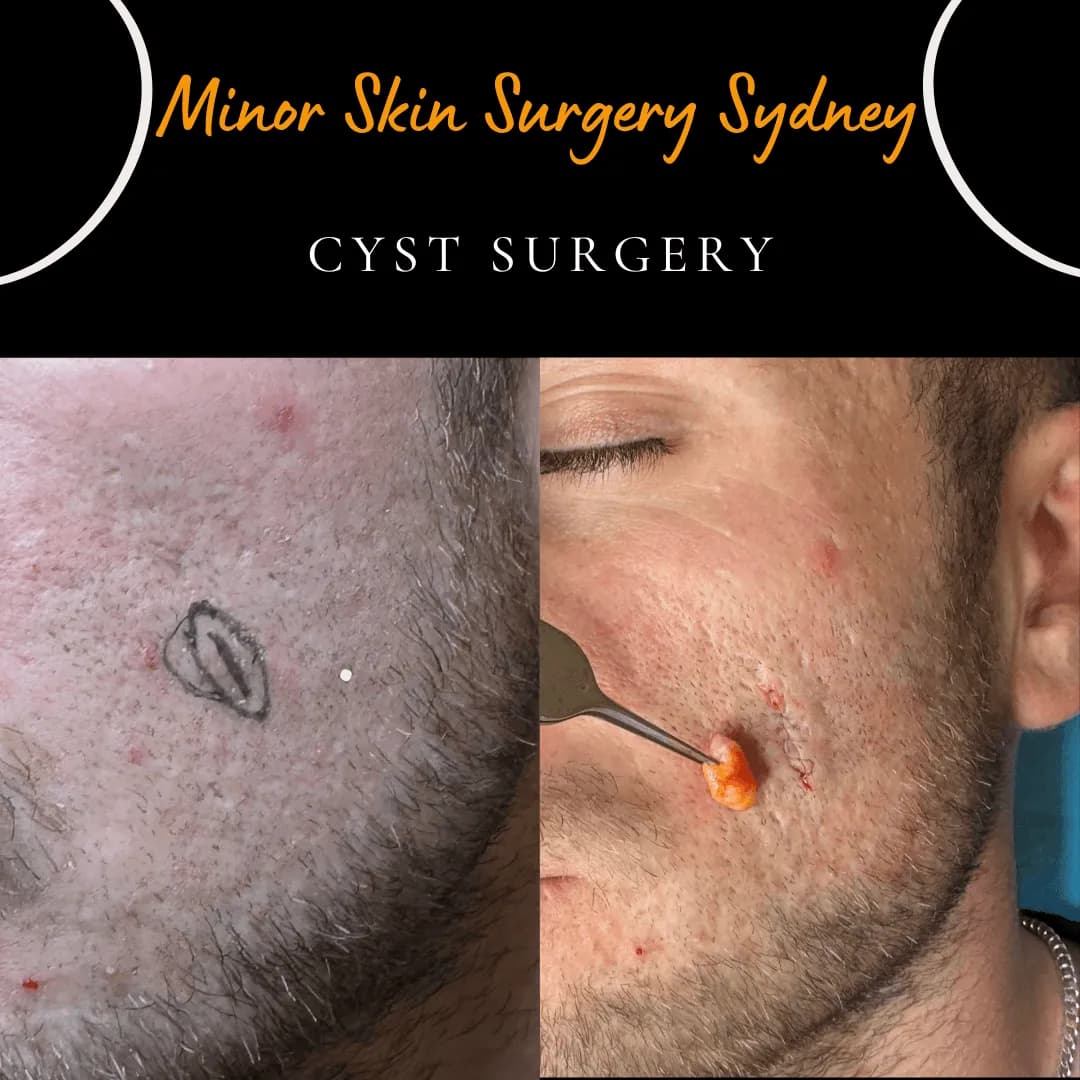
Sebaceous Cyst of the Cheek
This patient presented with a slowly enlarging cyst on the cheek that had been present for several years. Although it was painless, the patient became increasingly concerned about its appearance because it was clearly visible in photographs.
After clinical assessment, the cyst was removed under local anaesthetic on the same day as the consultation. Care was taken to place the incision within the natural skin lines to achieve the best cosmetic outcome. The patient returned one week later for suture removal and the wound healed well.
Recurrent Facial Cyst Following Previous Surgery
This patient had previously undergone cyst removal elsewhere but noticed that the lump gradually returned over several years.
During surgery, residual cyst wall was identified beneath the previous scar. The remaining capsule was carefully removed to minimise the chance of further recurrence.
Recurrence can occur if part of the cyst lining remains after previous surgery.
Facial Cyst Following Multiple Courses of Antibiotics
The patient experienced repeated episodes of infection over several years and had completed numerous courses of oral antibiotics.
Although the infections settled temporarily, the lump continued to return.
After the inflammation resolved, the cyst was completely excised under local anaesthetic. Histopathology confirmed a benign epidermoid cyst.
Scalp Cysts
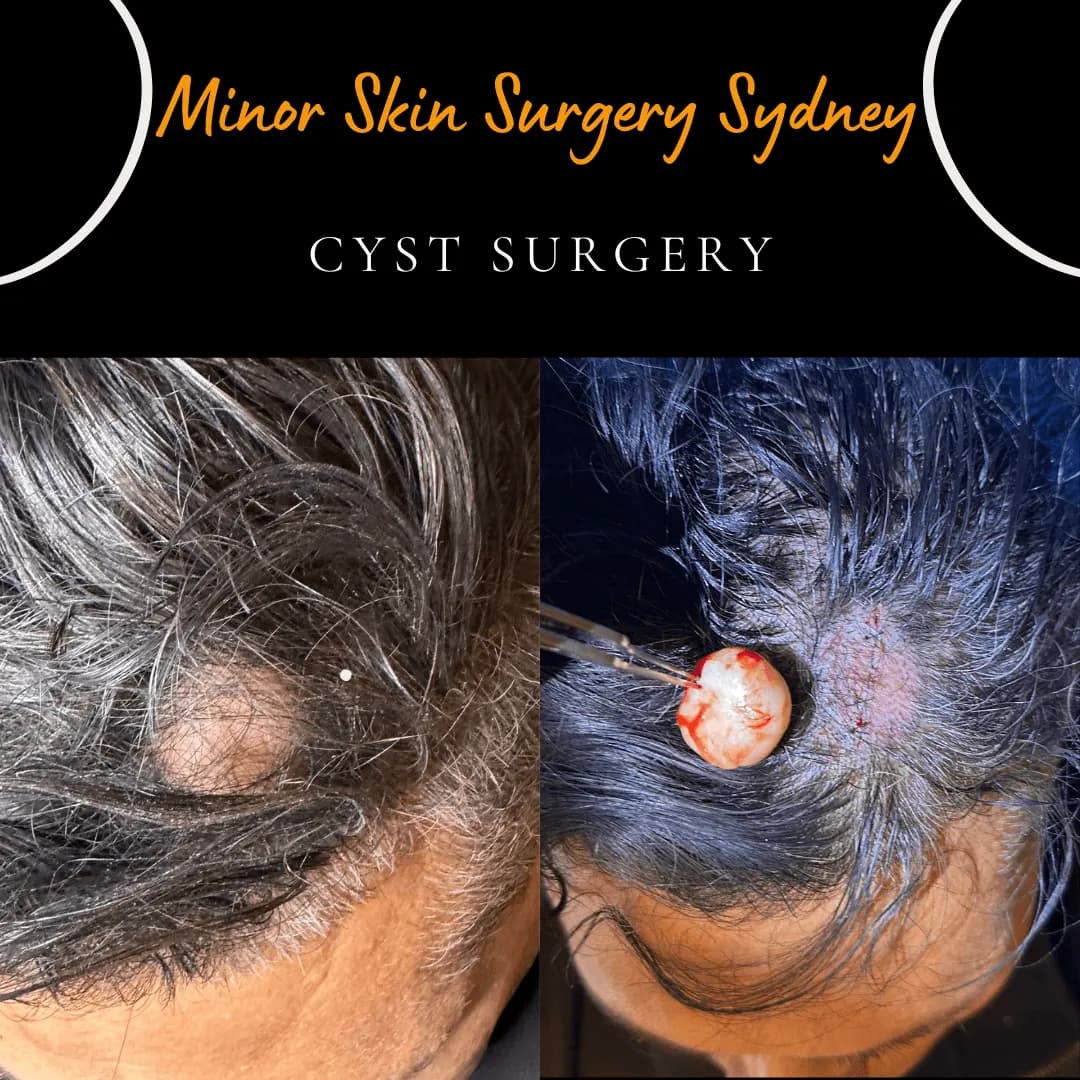
Pilar Cyst of the Scalp
Pilar cysts are particularly common on the scalp.
This patient presented with a slowly enlarging scalp lump that had become uncomfortable when brushing the hair.
Following examination, the cyst was removed under local anaesthetic as a same-day procedure.
Hair usually grows through the scar once healing has occurred, making the scar difficult to notice.
Large Scalp Cyst
This patient delayed treatment for several years because the cyst was hidden beneath the hair.
Over time it enlarged significantly and became difficult to conceal.
The cyst was removed under local anaesthetic, allowing complete removal of the cyst wall while preserving the surrounding healthy tissue.
Partially Ruptured Scalp Cyst
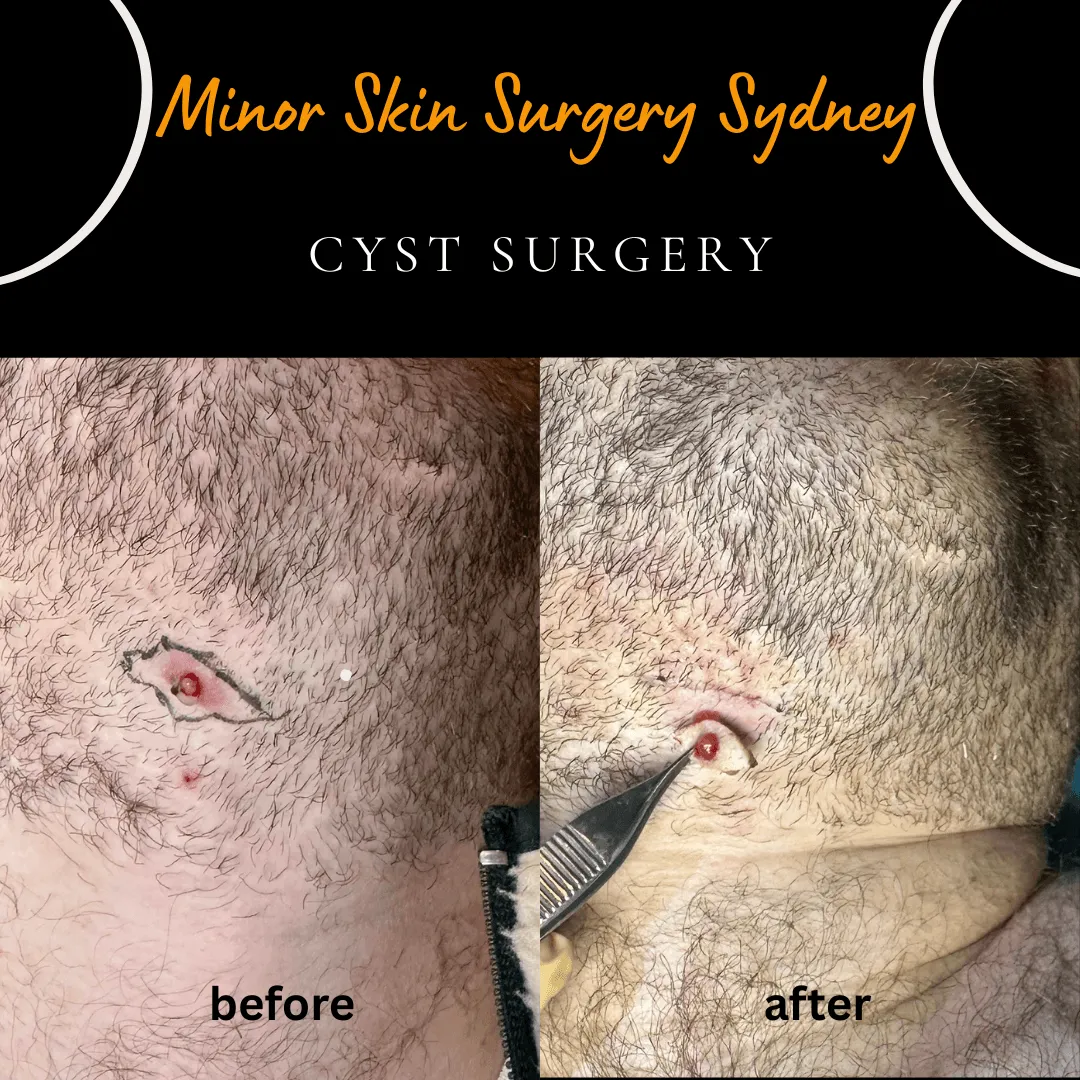
The patient reported that the cyst had burst several times over the previous few years.
Repeated rupture caused scarring around the cyst, making surgery more technically challenging.
Complete removal of the remaining capsule was performed to reduce the likelihood of recurrence.
Forehead Cysts

π 02 9411 4880 or 0433 284 880
Β
Β
Neck Cysts
Enlarging Neck Cyst
A patient presented with a lump that had slowly enlarged over two years.
Because of its location close to important structures in the neck, an ultrasound examination was arranged before surgery.
Following review of the imaging, the lesion was removed safely under local anaesthetic.
Neck Lump That Was Not a Cyst
This patient was referred with a diagnosis of a cyst.
Clinical examination and imaging suggested the possibility of another condition.
Following removal, pathology demonstrated a benign salivary gland tumour rather than a cyst.
This illustrates why not every lump beneath the skin is actually a sebaceous cyst.
Ear Cysts
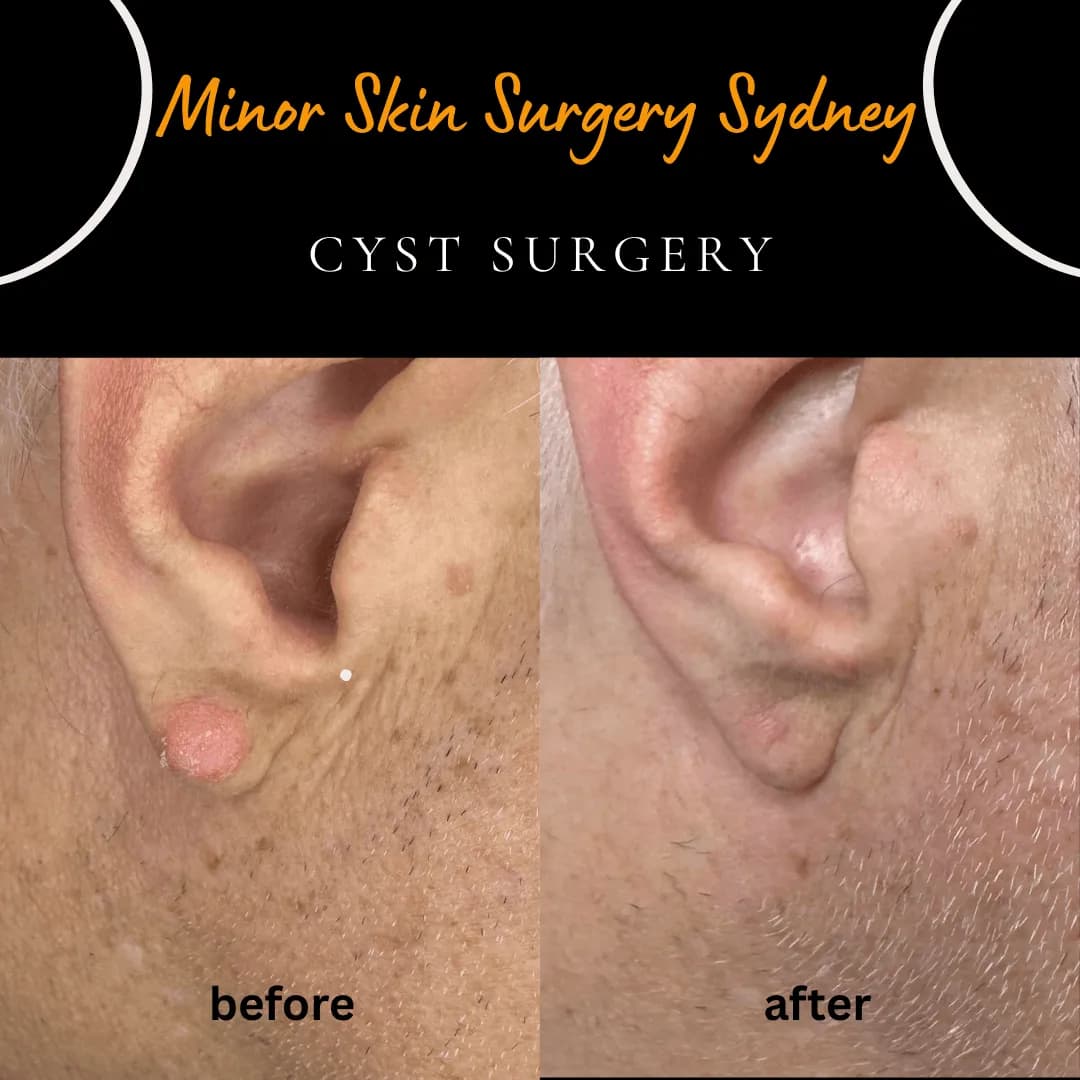
Ear Lobe Cyst
The patient presented with a cyst involving the earlobe that had slowly increased in size.
The lesion was removed under local anaesthetic with careful attention to preserving the normal contour of the ear.
Healing was uncomplicated.
Cyst Behind the Ear
This patient developed a cyst behind the ear which repeatedly became irritated by glasses.
Same-day removal under local anaesthetic relieved the symptoms and prevented further episodes of inflammation.
Eyelid Cysts
Chalazion
This patient presented with a persistent eyelid lump that had failed to resolve despite conservative treatment.
Following assessment, the lesion was removed under local anaesthetic.
The eyelid healed well and the cosmetic appearance improved significantly.
Β
Eyelid Epidermoid Cyst
A small cyst near the eyelid margin gradually enlarged over several years.
Because the eyelid is a delicate cosmetic area, careful surgical planning was undertaken to minimise scarring while completely removing the lesion.
Shoulder and Back Cysts
Longstanding Shoulder Cyst
Β
The patient had noticed the lump for approximately five years.
Although initially painless, it gradually enlarged and frequently caught on clothing.
The cyst was removed under local anaesthetic during the same visit.
Large Back Cyst
A patient presented with a large cyst on the back that had become increasingly uncomfortable when sitting.
Complete excision of the cyst wall was performed under local anaesthetic.
The patient returned one week later for review with satisfactory wound healing.
Two Symptomatic Back Cysts
This patient had two separate cysts on the back.
One had recently stopped draining and rapidly enlarged.
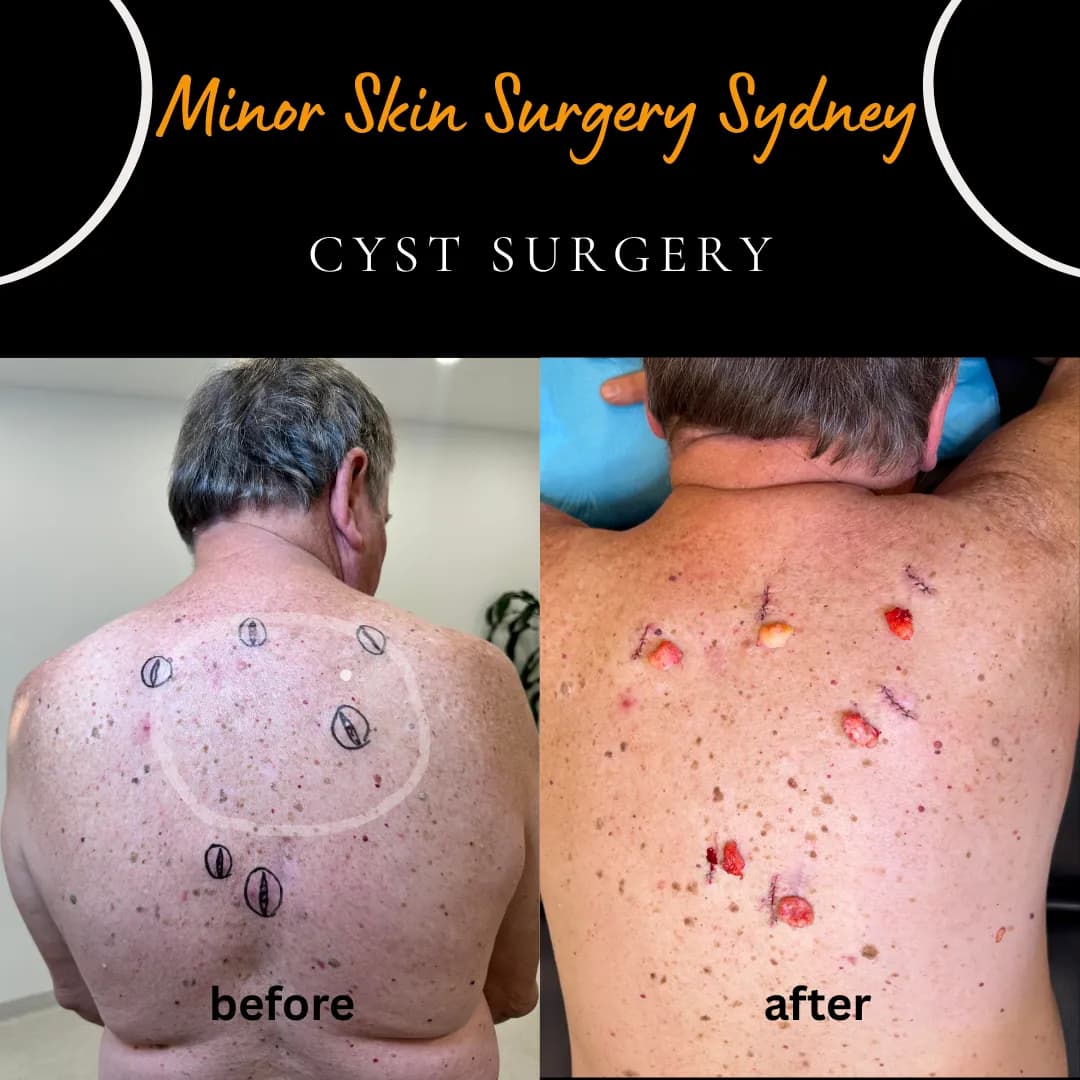
Both lesions were removed during the same procedure under local anaesthetic.
Chest Cysts
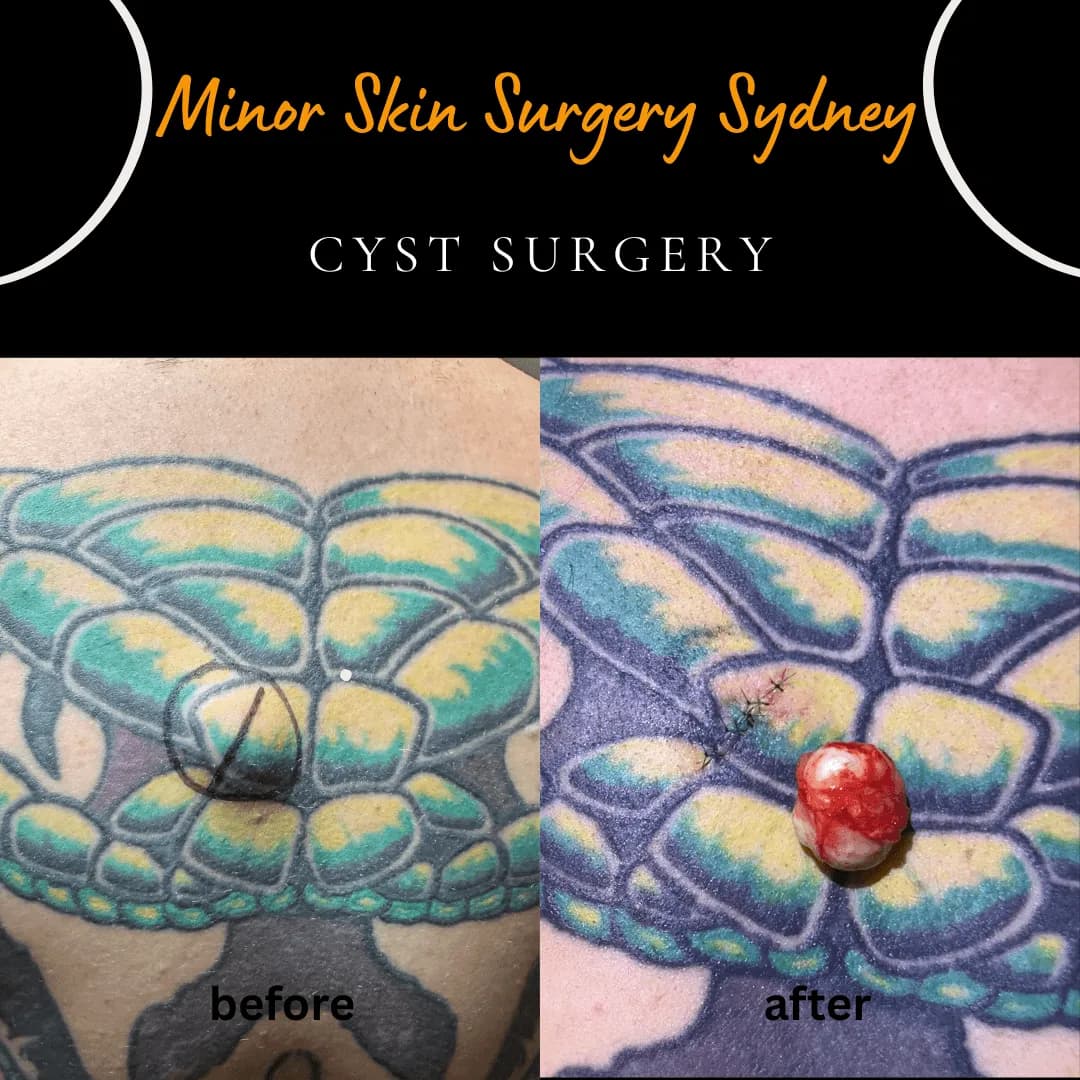
Chest Wall Cyst
The patient presented with a slowly enlarging chest wall cyst that became irritated by clothing.
The lesion was removed under local anaesthetic with primary closure.
Recovery was uncomplicated.
Cyst Near the Nipple
A cyst adjacent to the nipple required careful planning because of its sensitive anatomical location.
Following assessment, the lesion was successfully removed under local anaesthetic as a day procedure.
Infected Cysts
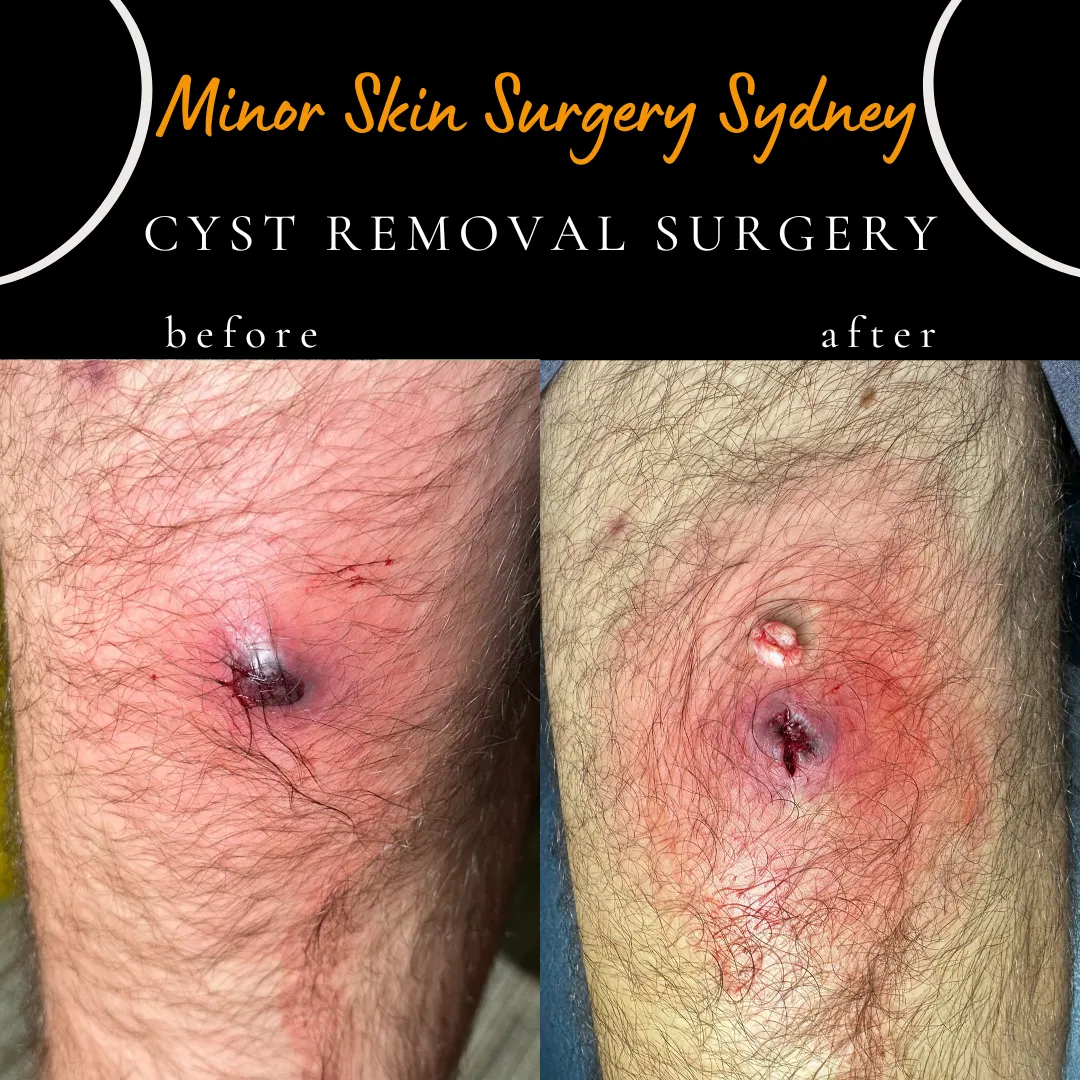
Recently Infected Cyst
This patient initially presented with an infected cyst and surrounding abscess.
The infection was treated with drainage and antibiotics.
Four weeks later, once the inflammation had settled, the remaining cyst capsule was removed to reduce the risk of recurrence.
This staged approach often provides the best long-term outcome.
Previously Drained Cyst
The patient reported several previous episodes of drainage over many years.
Although the cyst repeatedly emptied, it continued to recur because the cyst wall remained beneath the skin.
Complete excision finally resolved the problem.
Complex Cases
Umbilical Cyst
An ultrasound demonstrated a complex cyst within the umbilical region.
Because imaging could not completely exclude other conditions, surgical excision was recommended.
Pathology confirmed the diagnosis following removal.
Multiple Facial Cysts
This patient presented with several small facial cysts.
Removing every lesion surgically would have produced multiple scars.
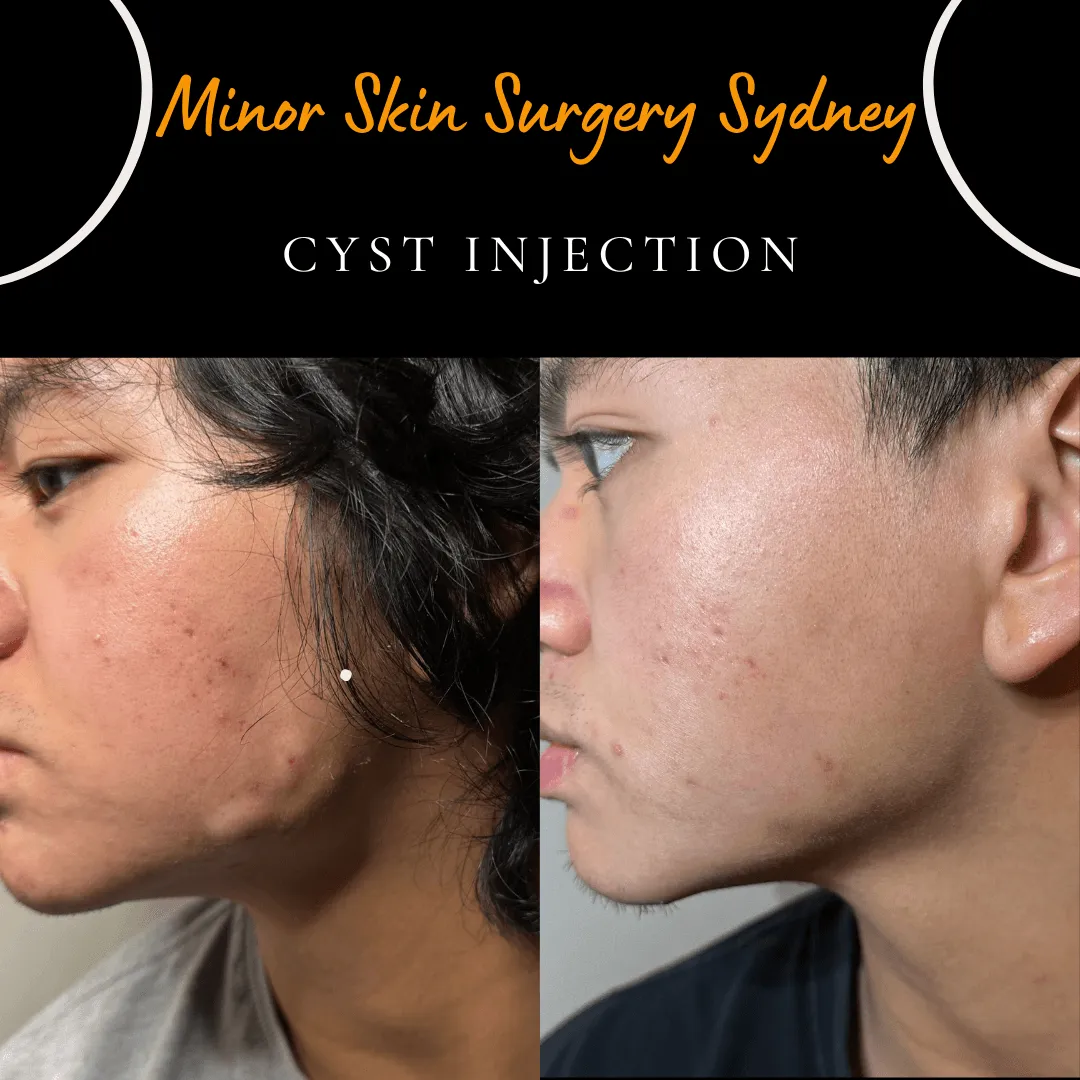
After discussion, conservative treatment with corticosteroid injections was attempted first to minimise scarring.
Only persistent lesions required surgery.
Large Cysts
Giant Sebaceous Cyst
The patient delayed treatment for several years until the lump became difficult to conceal beneath clothing.
Despite its size, the cyst was successfully removed under local anaesthetic without the need for hospital admission.
Rapidly Enlarging Cyst
This patient noticed rapid enlargement over only a few months.
Because of the recent change in size, surgical removal was recommended.
The cyst was excised during the same appointment, and pathology confirmed a benign epidermoid cyst.
Every Patient Is Different
No two cysts are exactly alike.
Treatment depends on many factors including:
- The location of the lesion
- Its size
- Whether it has previously ruptured
- Previous infections
- Previous surgery
- Cosmetic considerations
- General health
- Patient preferences
During your consultation, Dr Peter Kim will discuss the most appropriate management for your individual situation and explain the expected benefits, limitations and risks of treatment.
Clinical cases
The following are real patient cases involving cyst surgery performed by Dr Peter Kim in our clinic under local anaesthesia. These cases are presented for educational purposes only and are not intended to be promotional. Individual clinical circumstances, management decisions, and outcomes may vary.

This patient presented with a cyst that had previously been able to drain its contents when squeezed. However, over the past few months, the opening became blocked, causing the cyst to gradually increase in size.
Following assessment, the cyst was safely removed on the same day under local anaesthetic as a minor surgical procedure. The entire cyst wall was carefully excised to reduce the risk of recurrence, and the wound was closed with fine sutures to achieve the best possible cosmetic result.
Most patients are able to return to their normal daily activities shortly after the procedure, with minimal discomfort and a straightforward recovery.

This patient presented with a large sebaceous cyst that had been slowly growing over the previous two years. As the cyst was located in a delicate anatomical region, an ultrasound scan was performed before surgery to confirm the diagnosis and assess the underlying structures. For cysts in this location, Dr Peter Kim generally recommends an ultrasound examination before removal.
After assessment, the cyst was removed under local anaesthesia on the same day as the consultation. The procedure was completed comfortably without the need for hospital admission or a general anaesthetic.
The sutures are scheduled to be removed one week after surgery, allowing sufficient time for wound healing. The patient was also planning an international work trip and was able to travel two weeks after the procedure, with adequate time for recovery.
Many sebaceous cysts can be safely removed as a same-day procedure under local anaesthesia, allowing patients to return to their normal activities with minimal downtime.
π Pls call 02 94114880 or 0433 284 880 to schedule an appointment to see me.
π Locations: Chatswood and Cabramatta in Sydney.
π Opening Hours: 9:00 AM β 5:00 PM (WedβSat). We only take appointments and enquiries during our opening hours.

This cyst was classified as complex on ultrasound, meaning a definitive diagnosis was required. In these situations, surgical removal is often the best option, as it allows the lesion to be examined and confirmed by pathology.


Same-day surgery of the cyst performed under local anaesthesia.
π Please call 02 9411 4880 or 0433 284 880 to schedule an appointment with me.
π Locations: Chatswood & Cabramatta, Sydney.
π Opening Hours: 9:00 AM β 5:00 PM (Wednesday to Saturday).


To arrange a consultation, please contact the clinic:
π 02 9411 4880 | 0433 284 880
π Chatswood & Cabramatta
π WedβSat | 9:00 AM β 5:00 PM


To arrange a consultation, please contact the clinic:
π 02 9411 4880 | 0433 284 880
π Chatswood & Cabramatta
π WedβSat | 9:00 AM β 5:00 PM
Clinic locations: Chatswood & Cabramatta, NSW
Opening hours: Wednesday β Saturday | 9:00 AM β 5:00 PM
Phone: (02) 9411 4880 β’ 0433 284 880

Clinic locations: Chatswood & Cabramatta, NSW
Opening hours: Wednesday β Saturday | 9:00 AM β 5:00 PM
Phone: (02) 9411 4880 β’ 0433 284 880
Clinic locations: Chatswood & Cabramatta, NSW
Opening hours: Wednesday β Saturday | 9:00 AM β 5:00 PM
Phone: (02) 9411 4880 β’ 0433 284 880

Clinic locations: Chatswood & Cabramatta, NSW
Opening hours: Wednesday β Saturday | 9:00 AM β 5:00 PM
Phone: (02) 9411 4880 β’ 0433 284 880

Clinic locations: Chatswood & Cabramatta, NSW
Opening hours: Wednesday β Saturday | 9:00 AM β 5:00 PM
Phone: (02) 9411 4880 β’ 0433 284 880

Clinic locations: Chatswood & Cabramatta, NSW
Opening hours: Wednesday β Saturday | 9:00 AM β 5:00 PM
Phone: (02) 9411 4880 β’ 0433 284 880
Clinic locations: Chatswood & Cabramatta, NSW
Opening hours: Wednesday β Saturday | 9:00 AM β 5:00 PM
Phone: (02) 9411 4880 β’ 0433 284 880

Clinic locations: Chatswood & Cabramatta, NSW
Opening hours: Wednesday β Saturday | 9:00 AM β 5:00 PM
Phone: (02) 9411 4880 β’ 0433 284 880

Clinic locations: Chatswood & Cabramatta, NSW
Opening hours: Wednesday β Saturday | 9:00 AM β 5:00 PM
Phone: (02) 9411 4880 β’ 0433 284 880

Clinic locations: Chatswood & Cabramatta, NSW
Opening hours: Wednesday β Saturday | 9:00 AM β 5:00 PM
Phone: (02) 9411 4880 β’ 0433 284 880

Clinic locations: Chatswood & Cabramatta, NSW
Opening hours: Wednesday β Saturday | 9:00 AM β 5:00 PM
Phone: (02) 9411 4880 β’ 0433 284 880
Clinic locations: Chatswood & Cabramatta, NSW
Opening hours: Wednesday β Saturday | 9:00 AM β 5:00 PM
Phone: (02) 9411 4880 β’ 0433 284 880

Clinic locations: Chatswood & Cabramatta, NSW
Opening hours: Wednesday β Saturday | 9:00 AM β 5:00 PM
Phone: (02) 9411 4880 β’ 0433 284 880

Clinic locations: Chatswood & Cabramatta, NSW
Opening hours: Wednesday β Saturday | 9:00 AM β 5:00 PM
Phone: (02) 9411 4880 β’ 0433 284 880

Clinic locations: Chatswood & Cabramatta, NSW
Opening hours: Wednesday β Saturday | 9:00 AM β 5:00 PM
Phone: (02) 9411 4880 β’ 0433 284 880

Clinic locations: Chatswood & Cabramatta, NSW
Opening hours: Wednesday β Saturday | 9:00 AM β 5:00 PM
Phone: (02) 9411 4880 β’ 0433 284 880

Clinic locations: Chatswood & Cabramatta, NSW
Opening hours: Wednesday β Saturday | 9:00 AM β 5:00 PM
Phone: (02) 9411 4880 β’ 0433 284 880

Clinic locations: Chatswood & Cabramatta, NSW
Opening hours: Wednesday β Saturday | 9:00 AM β 5:00 PM
Phone: (02) 9411 4880 β’ 0433 284 880
Clinic locations: Chatswood & Cabramatta, NSW
Opening hours: Wednesday β Saturday | 9:00 AM β 5:00 PM
Phone: (02) 9411 4880 β’ 0433 284 880

Clinic locations: Chatswood & Cabramatta, NSW
Opening hours: Wednesday β Saturday | 9:00 AM β 5:00 PM
Phone: (02) 9411 4880 β’ 0433 284 880

Clinic locations: Chatswood & Cabramatta, NSW
Opening hours: Wednesday β Saturday | 9:00 AM β 5:00 PM
Phone: (02) 9411 4880 β’ 0433 284 880
Clinic locations: Chatswood β’ Cabramatta, NSW
Phone: (02) 9411 4880 β’ 0433 284 880
Clinic locations: Chatswood β’ Cabramatta, NSW
Phone: (02) 9411 4880 β’ 0433 284 880
Clinic locations: Chatswood β’ Cabramatta, NSW
Phone: (02) 9411 4880 β’ 0433 284 880

Clinic locations: Chatswood β’ Cabramatta, NSW
Phone: (02) 9411 4880 β’ 0433 284 880
Β
Clinic locations: Chatswood β’ Cabramatta, NSW
Phone: (02) 9411 4880 β’ 0433 284 880

Clinic locations: Chatswood β’ Cabramatta, NSW
Phone: (02) 9411 4880 β’ 0433 284 880

Clinic locations: Chatswood β’ Cabramatta, NSW
Phone: (02) 9411 4880 β’ 0433 284 880

Clinic locations: Chatswood β’ Cabramatta, NSW
Phone: (02) 9411 4880 β’ 0433 284 880

Clinic locations: Chatswood β’ Cabramatta, NSW
Phone: (02) 9411 4880 β’ 0433 284 880

Clinic locations: Chatswood β’ Cabramatta, NSW
Phone: (02) 9411 4880 β’ 0433 284 880


Clinic locations: Chatswood β’ Cabramatta, NSW
Phone: (02) 9411 4880 β’ 0433 284 880
Clinic locations: Chatswood β’ Cabramatta, NSW
Phone: (02) 9411 4880 β’ 0433 284 880

π 02 9411 4880 or 0433 284 880

π 02 9411 4880 or 0433 284 880

π 02 9411 4880 or 0433 284 880

π 02 9411 4880 or 0433 284 880

π 02 9411 4880 or 0433 284 880


π 02 9411 4880 or 0433 284 880


π 02 9411 4880 or 0433 284 880


π 02 9411 4880 or 0433 284 880


π 02 9411 4880 or 0433 284 880

π 02 9411 4880 or 0433 284 880

π 02 9411 4880 or 0433 284 880
Β
More cases
Β

Scalp cyst removal is a straightforward day procedure that usually takes less than an hour, allowing most patients to return home shortly afterwards.
If you have multiple cysts, we are happy to offer discounted treatment when several lesions are removed during the same visit.
All procedures are personally performed by Dr Peter Kim.
π Book a consultation
(02) 9411 4880
0433 284 880
π Locations: Chatswood & Cabramatta, Sydney